Working vs. Working Well: Seth Marrs on the ICM Maturity Gap Most Comp Teams Can’t See
Ask a room full of comp leaders whether their process takes more effort than it should, and hands go up everywhere. It's a common trap: a comp program that works now doesn't mean it'll still work in 18 months, once complexity increases. That gap, between “working” and “working well,” tends to get more expensive the longer it goes unaddressed.
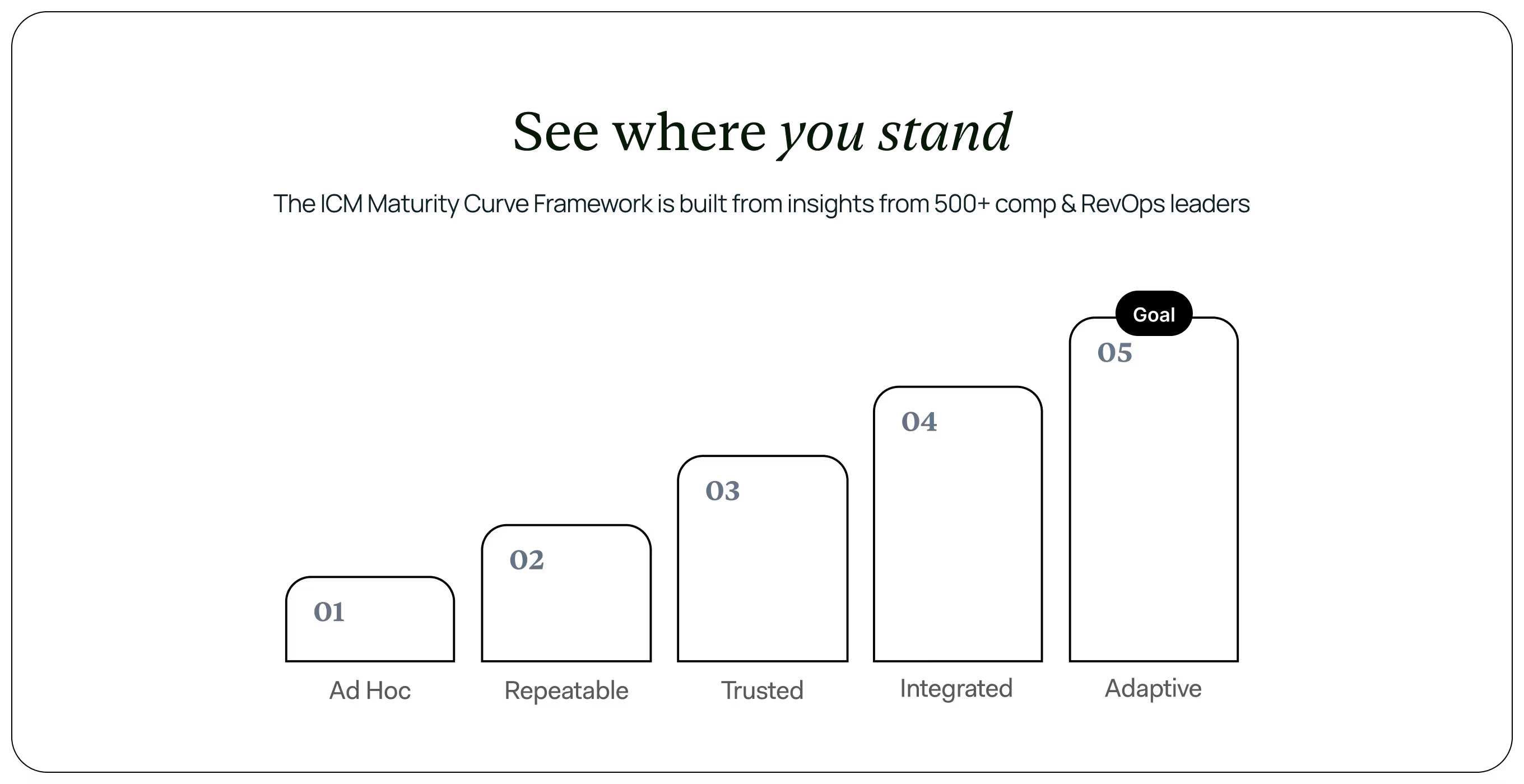
CaptivateIQ's Five-Stage Maturity Framework for Comp Leaders, released earlier this year, maps how programs mature across five stages: Ad Hoc (manual, spreadsheet-driven), Repeatable (standardized but still hands-on), Trusted (automated and credible enough that people stop double-checking it), Integrated (connected to territory and quota planning), and Adaptive (fast enough to model plan changes before they go live). Most teams don't sit neatly in one stage — which is exactly the gap this conversation gets into.
We invited Seth Marrs to walk through these ideas at Captivate '26 because he's seen this gap from three different seats: as an operator who ran sales and comp organizations himself, as the analyst hundreds of companies called when their programs stopped scaling, and now as a strategy executive still close enough to the work to know what's changed. That combination — building it, then watching hundreds of others try to build it — is exactly the vantage point a maturity framework needs.
You’re Probably Not Where You Think You Are
“Based on what I’ve seen, most people would look at the five-stage framework and say they’re in Stage Three — Trusted,” Seth said. “But from my experience working with clients, most people are actually in Stage Two. And there’s one really important reason why: data integrations.”
“Many, many, many companies struggle to do data integrations well,” he said. “I would bet that if I sat down with people who say they’re at Stage Three, and started working through what that looked like, you’d see most of them are struggling to get that integration work done. They do a great job, they’re making things go — but that piece is difficult.”
It’s an easy mistake to make, because the confusion often starts with the platform itself. “The biggest thing I’ve seen is you’re just doing calculations,” Seth said — pushing outputs into another tool to generate the documents that tell people what they’re being paid. “That’s largely why people buy compensation tools, but it also keeps them stuck in Stage One or Stage Two, because you’re still doing the lion’s share of the work outside of your ICM platform.”
Seth has watched what trust in the underlying data looks like at each stage, and the arc is consistent. “At the beginning, at Stage One, it’s, ‘Holy crap, we have a data problem.’ You’re throwing resources at it just to keep the comp plans accurate. When you get into Stage Two, you’ve pretty much tackled that — it’s duct tape and glue, but it’s working. Stage Three is when you start to automate those things, and you have throughput with data, so it’s not as big of a deal. You’re more monitoring it than managing it. Stage Four, you extend that out and use the information to create territories, to create quotas. And Stage Five is when you start really accelerating outside of just compensation.”
The stakes for getting this right, he argued, are bigger than most comp teams realize. “You have the most accurate source of information around performance for your sellers, and sellers are the most critical investment a company makes to drive growth. That data should be much more sought after than it is currently — and it will be.”
CaptivateIQ’s own Maturity Framework report backs up how common Seth’s Stage Three self-diagnosis is: 51% of organizations say they regularly review their sales plan to determine whether incentive changes are required, a hallmark of Stage Three thinking. Whether the systems underneath that review are integrated well enough to earn the label is the harder, less comfortable question.
The Real Test of Trust
If data integration is what separates a real Stage Three from a self-diagnosed one, trust between the comp team and its own systems is what makes the jump possible. The Stage Two-to-Three transition is often described as the moment comp goes from technically accurate to organizationally credible — reps stop asking “Is this right?” and start asking “How do I earn more?” Asked what has to change to get there, Seth located the harder version of that shift somewhere else entirely.
“The hardest place to get trust is with your comp admins and your compensation team,” he said. “Because of the enormity of what you’re doing — you make a mistake, someone doesn’t get paid — that is not a mistake you want to make, and you really don’t want to make it twice.”
The tell, in his experience, is almost anticlimactic. “You know you’ve done it when the admin goes from, ‘I’m making the data accurate’ to ‘My system is keeping the data accurate, and I’m just monitoring it.’ That is a massive, massive leap. If your comp admins — who are going to be the most critical of that information, the most knowledgeable about it — are ready to let it go and run in an automated fashion, that’s when you know you’ve moved into Stage Three.”
Asked what that trust looks like day to day, Seth kept it simple. "You're not going to get compliments on your data — nobody says, 'hey, thanks for the accurate numbers.' But if you're not getting complaints from your team that it's wrong, then it's trusted." The harder tell is on the admin side: “If you see this flowing and your comp admins have actually stepped away from it, there’s trust — because they understand the consequences of it.” The real challenge for most teams, he added, is getting admins comfortable stopping at one check instead of running four or five before they'll let a number out the door.
When the Plan Breaks
Moving into Stage Three to Four — where comp connects to territory design and quota setting — is where a well-built plan can still fail for reasons that have nothing to do with compensation. When asked what actually breaks when those systems stay disconnected, Seth laid out a common scenario:
A team builds a plan everyone loves, accelerators in place, thresholds dialed in, built on the premise that fifty percent of the team will land over plan. Then it goes live — and four people go above quota. “Is your plan any good? It’s not. It’s completely ruined, because you built it on a model that didn’t materialize. Usually, the reason it didn’t materialize is because your quotas and territories weren’t aligned in a way to make it materialize.”
“No matter how good your comp plan is,” he continued, “if you can’t properly predict how the numbers are going to distribute, you can’t make your comp plan work. Those two have to work hand-in-hand.”
The counterintuitive part is what happens as companies grow. Most leaders assume scale forces better alignment between comp and planning. Seth sees the opposite. “Company size actually makes it worse. The bigger your company gets, the more complicated your comp plan gets, the more resources you’re putting into it, the more focus it takes to make it go right — and the more distracted you become from things like territories and quotas.”
He pointed to a stat from his own research to make the point concrete: “We asked, ‘How many of you have a territory and quota solution?’ About sixty percent said they had one. The follow-up was, ‘How many of you are actually using that system?’ Ten percent were using it.” Everyone wants territories and quotas done well, he said, but the daily gravity of getting compensation accurate pulls resources away from the planning work that would make the comp plan actually hold up.
It’s a gap CaptivateIQ sees from the other direction, too: only 34% of organizations report from a single source of truth for sales planning and incentive data, and just 32% manage planning and incentives in the same tool, according to the Maturity Framework report. Reaching Stage Four, in other words, still puts a company well ahead of most of its peers.
Running at the Speed of the Deal
Stage Five — Adaptive — is where Seth’s answer stopped being about process and started being about pace. Asked what’s different about teams that get there, he gave a one-word answer: “Speed.”
“In a lot of companies, it takes a month, two months, three months just to get the data accurate enough to hand out,” he said. “When you get to Stage Five, Adaptive, all of that’s behind you, and you’re working to operationalize that data instead.” The framework’s own research backs up how widespread that lag is: 39% of organizations take one to two months to make a plan change live, another 37% take two to four weeks, and only 12% can implement a change in under two weeks. That shift changes what the job of a comp admin actually is. "You're going to see comp admins pulled out of the back office — 'is my comp accurate?' — and into the front of the business — 'what do I need to do to drive growth?'"
He connected that shift to a mismatch he saw firsthand at Forrester between how companies plan and how buyers actually behave. “There’s a difference between a buying cycle and a selling cycle — a seller books a deal budgeted a year and a half out, but the buyer, once they get the green light, moves in four or five months.” As consumption models compress that gap further, he expects quota and territory cycles to compress with them: “What’s the difference between a quarterly quota and a forecast in that world? There really isn’t one.”
The framework report puts numbers behind the payoff: organizations that adjust their plans weekly are more than three times as likely to use AI extensively as those adjusting only as-needed, and 83% of weekly adjusters report feeling very prepared for economic volatility, compared to just 25% of annual adjusters. Speed and adaptability, in other words, aren’t separate capabilities — they compound together.
That reframes what comp admins are for. “It’s going to be up to the comp admin and that team, and how they transition their job into value,” he said. “The future is pushing you from back of house to front of house. And there is no shortage of need for people who understand data, understand what works, and understand how to implement it.”
It also shapes where he thinks AI is earning its keep in comp today, and where it isn't. "The real value is in it being assistive. Documentation is the best example — it's the best tool I've seen for creating it. Pre-creating a comp plan, a first draft it can run the numbers on — that works too. And if you're not using it to handle rep inquiries yet, you should be. Look at how much investment is going into contact centers right now, and think about what an agent there does versus what your inquiry line does."
Your Homework
Seth closed with an exercise that doesn't require new software — just a data gut check any comp leader can run this week.
"Look up your company's revenue growth for the last year. Lock that number down. Now go to your compensation — all-in, commissions, salary, spiffs, everything — and look at what that growth is. Compare the two. If your revenue growth number isn't within five or ten percent of your compensation growth number, something's wrong with your comp plan." Revenue outpacing comp usually means sellers are underpaid; comp outpacing revenue usually means the reverse. "It's a cool little exercise to get a feel for whether your program is actually on track. It’s also a good way to have a data-based conversation with an executive who wants to add another spiff, instead of an argument about whether you hit your number."
Seth's larger point, echoed in CaptivateIQ's own research, is that most organizations aren't operating at a single, clean stage — they're accurate in some dimensions and disconnected in others, and the value of a framework like this one is in naming the specific gap that's creating the most drag, rather than trying to fix everything at once.
Not sure which stage you're actually in? Take CaptivateIQ's two-minute ICM Maturity Quiz to get a real-time read on where your program actually stands — and where the framework says to focus next.
Want more from Seth? Watch Captivate 2026 on-demand to view his full session, as well as sessions from other industry leaders.
<hr>
Seth Marrs is Chief Strategy Officer at Sandler, where he leads strategic planning, value proposition development, and analyst relations. He spent six years as a VP, Principal Analyst at Forrester covering sales compensation and incentive compensation management, advising executives on sales operations, technology, and process optimization.
Lorem ipsum dolor sit amet, consectetur adipiscing elit. Suspendisse varius enim in eros elementum tristique. Duis cursus, mi quis viverra ornare, eros dolor interdum nulla, ut commodo diam libero vitae erat. Aenean faucibus nibh et justo cursus id rutrum lorem imperdiet. Nunc ut sem vitae risus tristique posuere.
