Spotlight on Agile Capacity Planning: Turning Ramp Risk into Resilience
When capacity assumptions slip, the ripple effects can pull quotas, territories, and incentives out of alignment, putting revenue goals at risk. Capacity is uniquely challenging to plan: it’s a moving target, shaped by factors that resist precise forecasting, like hiring velocity, ramp curves, and attrition.
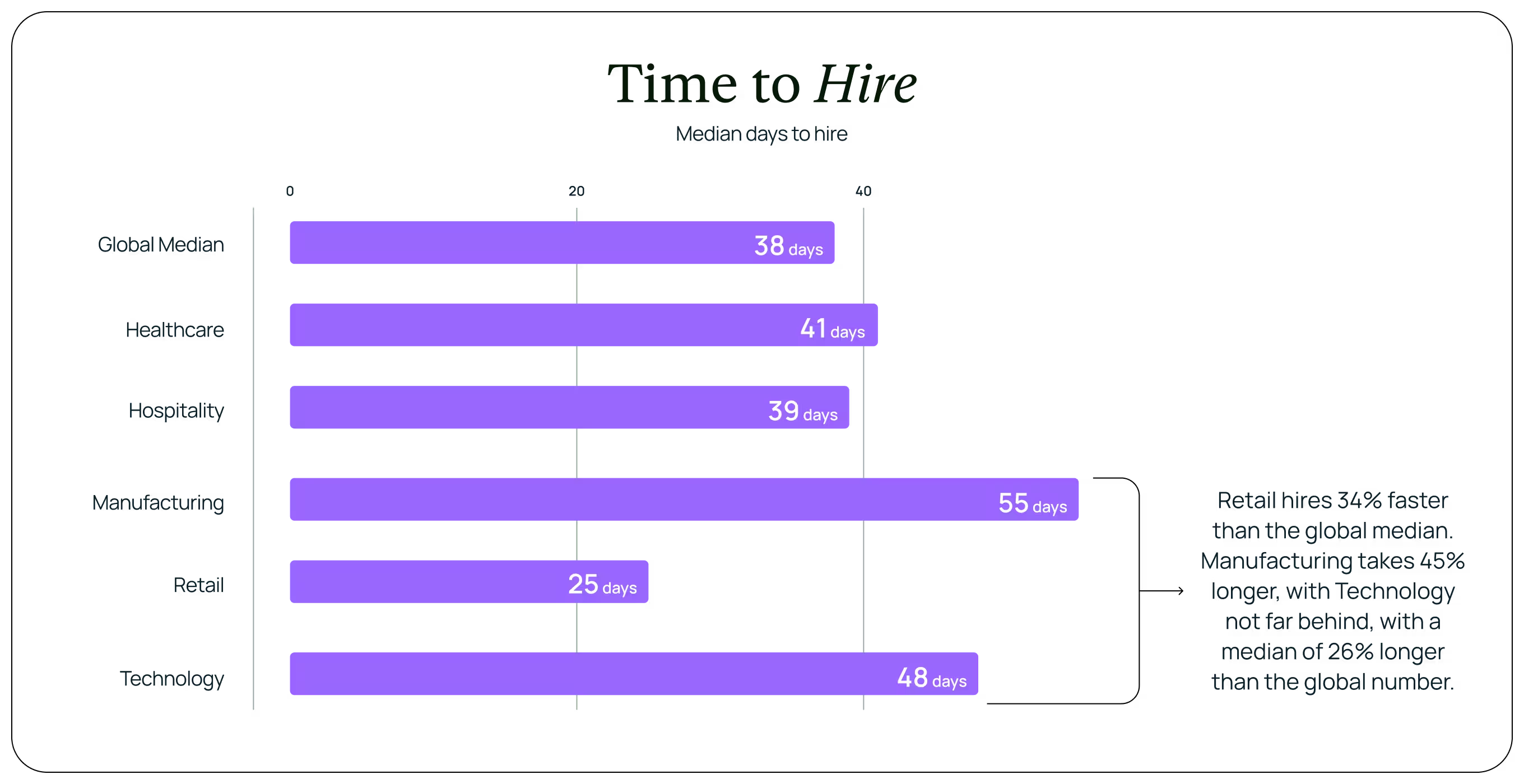
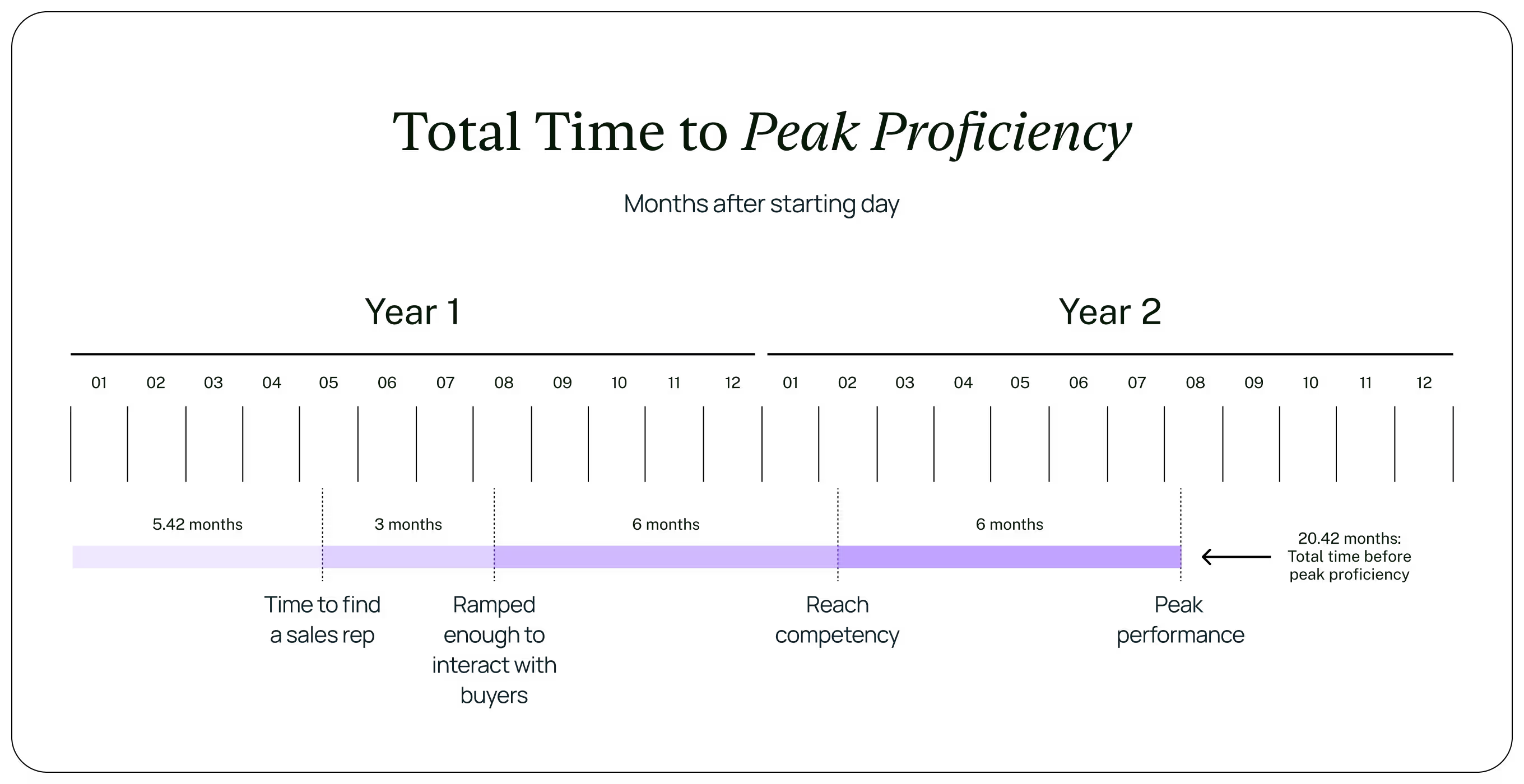
In 2025 nearly 69% of U.S. organizations reported difficulty recruiting full-time roles, and 76% of employers globally said they’re struggling to fill positions. Sales and marketing talent is especially hard to come by – it’s the third most-difficult technical skill for employers to find. Not to mention replacing a field seller takes 5.42 months, on average, and the average U.S. time-to-hire is 35 days.
Then comes the time required to ramp a new hire. New sellers typically need roughly three months to be ready to engage buyers, nine months to become competent, and up to 15 months to hit top performance. In SaaS, average AE ramp has lengthened to 5.7 months (from 4.3 in 2020), and 63% of companies now report ramp times of five months or more.
Layer on a roughly 30% annual turnover, with 19% involuntary and 11% voluntary, and it’s clear why capacity planning must be continuously modeled, monitored, and adjusted as conditions change.
Traditional planning tried to mask ramp risk with expensive buffers
Planning teams have always looked for ways to hedge against the uncertainty of hiring and ramp. Sure, the intent was sound: keep revenue plans safe even when hiring slipped or sellers ramped more slowly than expected. But these approaches came with high price tags and hidden trade-offs.
Overhiring
One common tactic was to staff above plan, bringing on 105–110% of the needed headcount to offset attrition or underperformance. On paper, this created a safety net. In practice, it meant paying for extra salaries, onboarding, and enablement costs that didn’t always convert into incremental revenue. When those “extra” hires failed to ramp, companies ended up with bloated teams and higher expense ratios.
Continuous recruiting
Another popular approach? Never turn recruiting off, even when headcount targets were technically full. Maintaining a constant pipeline or “warm bench” helped mitigate the shock of unexpected turnover, but it also consumed time and resources from HR and recruiting teams. Those resources could be directed toward more strategic hiring initiatives instead of maintaining a perpetual cycle of interviews and outreach that might never materialize into hires.
Sandbagging
Perhaps the most subtle buffer came in the form of sandbagging. Leaders would intentionally understate capacity by padding ramp curves, inflating attrition assumptions, or lowering productivity multipliers. This created room for error, but it also lowered expectations across the board. Revenue targets were set artificially low, leaving potential upside on the table and making it harder for companies to invest aggressively in growth.
The old way treated hiring uncertainty as something to be “buffered” against with extra cost, extra effort, or lowered expectations. The result: plans that were expensive to maintain and rarely precise. Agile capacity planning flips this approach by treating capacity as a dynamic variable, continuously monitored and adjusted in real time, rather than over-insured with costly safety nets.
The new way: agile capacity planning
Instead of relying on expensive buffers, agile capacity planning treats hiring and ramp as dynamic, living variables. Teams build models that account for real-world attrition, ramp curves, and hiring velocity, and then continuously update those assumptions as conditions change.
Rather than overhiring, over-recruiting, or sandbagging, leaders adjust plans in near real-time, aligning quotas, territories, and incentives to actual capacity. The result: leaner plans, smarter investments, and a sales organization that can flex with the market instead of padding against it.
How to infuse agility into your capacity planning
Agile capacity planning isn’t about predicting the future perfectly. It’s about equipping your team to adapt quickly when reality diverges from plan. The following strategies help make your capacity planning more responsive to real-time data and organizational shifts.
Tactic #1: Model multiple ramp scenarios based on hiring timelines and realistic rep readiness.
Start by creating at least three ramp models: best case, expected case, and delayed case. Each model should factor in realistic assumptions around time-to-hire, ramp duration, and early productivity rates. For example, if your average ramp time is four months, build one version that assumes reps hit full productivity in three months, one in four, and one in five.
Use historical ramp data from your CRM or performance management system to calibrate productivity curves, such as what percentage of quota new hires hit in months 1–6. Incorporate dependencies like training schedules, enablement resources, and territory assignments, which often delay readiness. Regularly refresh these scenarios with updated hiring data or market conditions. By running sensitivity analyses (e.g., how a one-month hiring delay affects quarterly attainment), you can quantify risk and prepare contingency plans before it becomes a revenue problem.
Tactic #2: Communicate hiring plans and ramp expectations across teams, ensuring organizational alignment.
Agile planning depends on transparency. Share hiring assumptions and ramp timelines with Finance, Recruiting, Enablement, and Sales Leadership. Use a centralized dashboard or planning tool to visualize open roles, time-to-fill, ramp stages, and expected contribution dates.
[BLOCKQUOTE
| Quote: Make sure your governance committee isn't just meeting for three to four months during the year to do your plan design and approval. It needs to meet throughout the year to make sure that you have that ongoing governance.
| Author: Rachel Parrinello
| Title: Principal and Sales Compensation Thought Leader, The Alexander Group
]
Hold a monthly or biweekly cross-functional sync to review updates: Is recruiting ahead or behind? Are new hires progressing as planned? Are there upcoming enablement bottlenecks? When everyone understands the same ramp model and timeline, downstream teams can adjust proactively. For instance, Enablement can schedule earlier onboarding, or Finance can adjust OTE budgets. A shared view keeps all stakeholders accountable and reduces finger-pointing when plans shift.
Tactic #3: Track hiring velocity, ramp progression, and attrition monthly.
Establish a recurring rhythm for tracking key capacity KPIs. At a minimum, monitor:
- Hiring velocity (time from requisition to start date)
- Ramp progression (percentage of hires achieving ramp milestones on schedule)
- Attrition rate (voluntary and involuntary, by tenure cohort)
Use cohort analysis to understand trends. For example, how Q1 hires compare to Q2 hires at the 90-day mark. Visualize this in dashboards that combine HR, CRM, and performance data. Any deviation from plan (e.g., slower-than-expected ramp or higher early attrition) should trigger an immediate review of hiring assumptions and enablement effectiveness.
Agile teams also document the “why” behind each variance. Did a hiring pause stall ramp? Did new enablement shorten time-to-productivity? Over time, this feedback loop improves forecast accuracy and prevents recurring blind spots.
Tactic #4: Shift assignments, adjust plans when coverage lags or hiring pauses.
Agility means acting when gaps appear. If hiring slows or reps ramp late, redistribute open territories or accounts temporarily to experienced sellers to preserve coverage. Use lead routing rules or automated account reassignment workflows to avoid disruption.
[BLOCKQUOTE
| Quote: Have some guidelines in terms of triggers. What are some data results that are going to trigger the need to make some updates, or maybe even trigger a SPIFF?
| Author: Rachel Parrinello
| Title: Principal and Sales Compensation Thought Leader, The Alexander Group
]
You can also deploy interim capacity levers, such as extending overlays, temporarily increasing SDR support, or assigning inside reps to high-priority accounts until ramp stabilizes. Revisit your quota and pipeline models monthly to reflect the latest headcount reality, ensuring targets remain achievable and equitable.
When hiring rebounds, reverse or rebalance assignments strategically, prioritizing customer continuity. The key is to view headcount as a fluid resource, constantly realigned to match where market opportunity and revenue risk are greatest.
Agile capacity planning in action: Real examples of how flexible teams stay ahead
Even the best-laid plans get tested by real-world volatility. The most effective sales planning teams don’t just react; they adapt in real time. Below are two examples of how agile teams adjust capacity midyear to stay aligned with revenue goals.
Example #1: Navigating a new product launch with highly variable ramp times
When the company launched a new AI product mid-year, productivity ramped unpredictably. Some reps were closing deals within three months, others took nearly 10. The ops team quickly realized that using a single “average ramp curve” was skewing capacity forecasts.
Instead, the planning team segmented sellers into cohorts based on experience, product expertise, and market focus. Then, they built dynamic ramp models for each cohort:
- Group A (experienced solution sellers) used a 3–4 month curve.
- Group B (generalist reps learning a new technical motion) used 6–8 months.
- Group C (new hires) were modeled at 9–10 months with lower initial quotas.
Weekly deal velocity reports and enablement progress were integrated into a live dashboard, allowing leadership to see who was ready to carry more quota weight. Territories and marketing support were rebalanced quarterly to direct pipeline toward faster-ramping cohorts while others continued skill development.
By treating ramp as a fluid, data-backed variable, the team preserved forecast accuracy and avoided overburdening underprepared reps.
Example #2: Addressing slower-than-expected ramp for two new hires
Two mid-market reps, expected to be fully ramped in three months, were still only hitting 50% productivity at month six. Instead of waiting for the annual review cycle, the RevOps team noticed the lag early through their monthly ramp dashboard.
They collaborated with Enablement and Sales Management to diagnose the issue: insufficient lead flow and inconsistent coaching.
The team responded by:
- Reassigning 20% of the reps’ lower-probability pipeline to tenured sellers to preserve coverage.
- Creating a tailored “micro-ramp” plan with reduced quota expectations and weekly skill check-ins.
- Adding SDR and BDR support to supplement prospecting until the reps reached full readiness.
Capacity models and forecasts were immediately updated to reflect realistic contribution levels. This transparency prevented leadership from over-projecting revenue and helped preserve trust across Finance and Sales. Within two months, the lagging reps were at 90% of plan, marking a clear win for proactive monitoring and agile adjustment.
Making agility the new advantage
Traditional planning treated uncertainty as something to shield against with costly buffers and lowered expectations. Agile capacity planning flips that logic: it transforms uncertainty into a strategic lever.
When hiring stalls, ramp stretches, or markets shift, agile teams don’t start from scratch. They already have the visibility and governance to reallocate, rebalance, and re-forecast in days, not quarters. That level of responsiveness doesn’t just protect plan integrity; it builds trust across the organization.
The future of sales capacity isn’t about locking in perfect forecasts. It’s about designing a system that can adapt, evolve, and thrive no matter what changes next.
Lorem ipsum dolor sit amet, consectetur adipiscing elit. Suspendisse varius enim in eros elementum tristique. Duis cursus, mi quis viverra ornare, eros dolor interdum nulla, ut commodo diam libero vitae erat. Aenean faucibus nibh et justo cursus id rutrum lorem imperdiet. Nunc ut sem vitae risus tristique posuere.
