The State of AI in Sales Planning: Adoption, Impact, and What Comes Next
Artificial intelligence (AI) has officially moved from experiment to expectation. As we enter 2026, sales organizations face a new mandate: use AI to unlock efficiency, accuracy, and growth, or risk falling behind. But while demand is high, comfort and maturity vary dramatically across industries, functions, and teams.
Today, we’ll outline the state of AI today in sales planning, incentive compensation, and broader go-to-market (GTM) operations, where it’s heading in 2026, and how growth-minded organizations can use it to get ahead.
The current state of AI in sales planning
Executives are turning up the pressure: 87% of sales leaders report a top-down push from CEOs and boards to implement GenAI, and 57% of executives cite tech and AI as a top investment priority for their revenue teams.
But enthusiasm does not automatically translate into maturity or trust. Adoption is uneven, largely because teams differ in how comfortable they feel with the technology.
Roughly 20% of marketing and sales teams in the insurance industry have reached the “scaling phase” of AI maturity, for example, while only 4% of engineering, construction, and financial services organizations report the same.
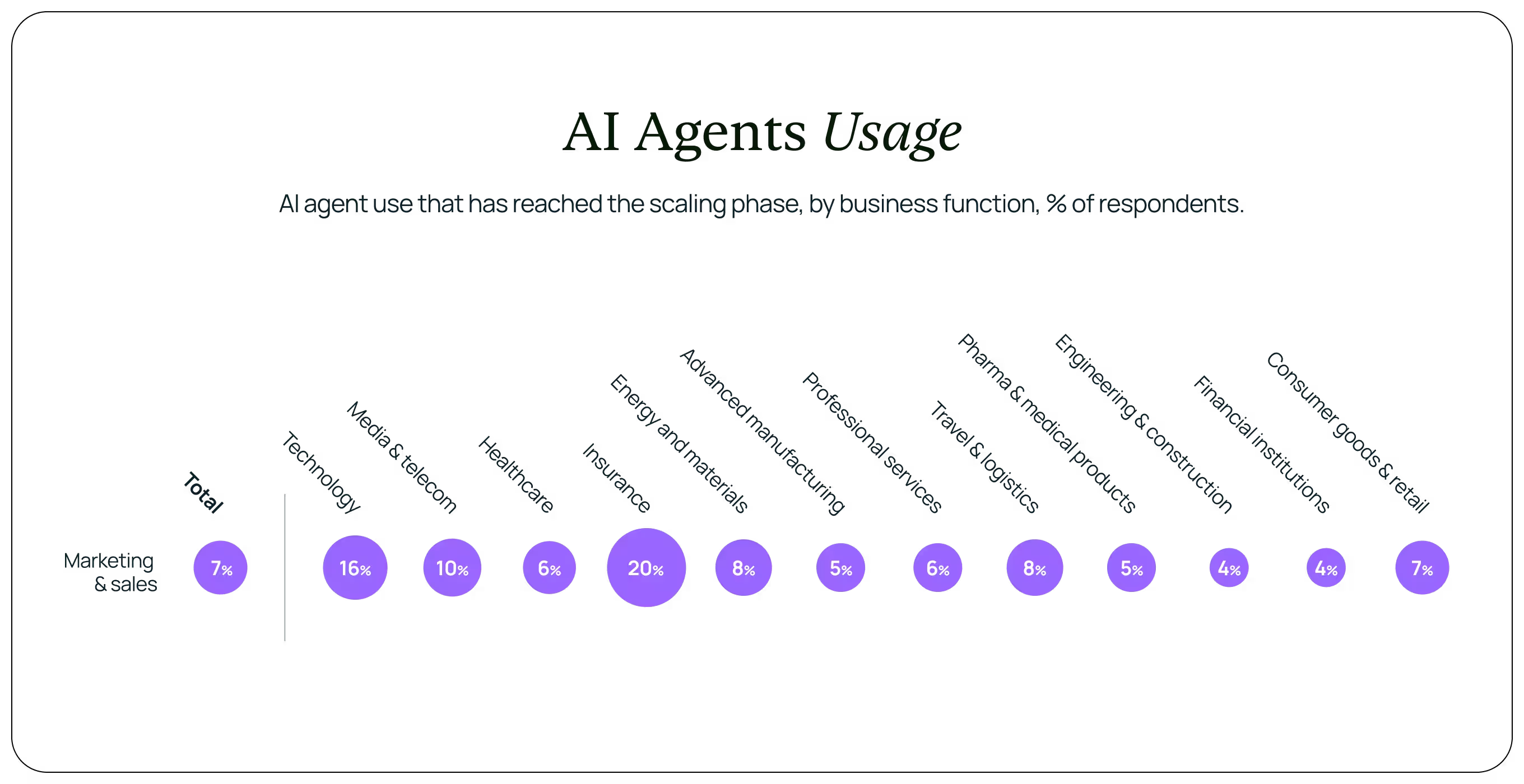
Some sectors are sprinting ahead; others are still in early testing phases, and that ramp-up period can take time.
[BLOCKQUOTE
| Quote: I have one large, tech client that’s been using machine learning (ML) for their quotas for the last five or six years… This year, for the first time, they will only allow leader adjustments by exception. Before, they would have their machines spit out the quota, and then they allowed leaders and managers to adjust it based on their knowledge. So, in five years they got that comfortable with their ML modeling. This shows that you need to get people used to the tool.
| Author: Rachel Parrinello
| Title: Principal of Sales Compensation, The Alexander Group for The Multiplier
]
Across incentive compensation organizations, most teams have begun using AI in some form, though depth of adoption varies. Twenty-two percent now use AI extensively, while 42% use it somewhat. Another quarter are exploring or considering AI but have not yet implemented it. Only 11% have no plans to adopt AI in the next year. This means two-thirds of compensation teams already use AI in their workflows, but only a subset have fully integrated it into core processes.
How AI is being used today
Most teams are starting with foundational, workflow-level applications. Today, 58% of compensation teams use AI to automate manual tasks, making it the most common entry point. Close behind, 56% rely on AI to summarize insights from reports, and 49% use it to help navigate tools or systems. These are classic “copilot” use cases: AI steps in as an assistant, not yet as a system that autonomously plans, decides, or executes.
The impact of these early applications is already visible. A majority of teams (61%) report that AI has reduced time spent on administrative work, while 58% have seen improvements in the accuracy of commission calculations. AI is also strengthening visibility and access: 55% of teams say it has improved real-time visibility for sellers, and 47% report better access to data and insights overall. Even rep enablement is benefiting, with 31% of organizations experiencing fewer inquiries from sellers, a sign that AI-generated clarity is beginning to replace confusion-driven support cycles.
For now, efficiency remains the dominant theme: faster cycles, fewer errors, cleaner data, and less manual lift. But these early wins are laying the groundwork for more strategic, high-impact use cases ahead.
The highest-performing teams use AI for more than efficiency
Across industries, 80% of companies set efficiency as their primary AI objective. But the organizations seeing the greatest value are using AI to drive something much bigger: growth.
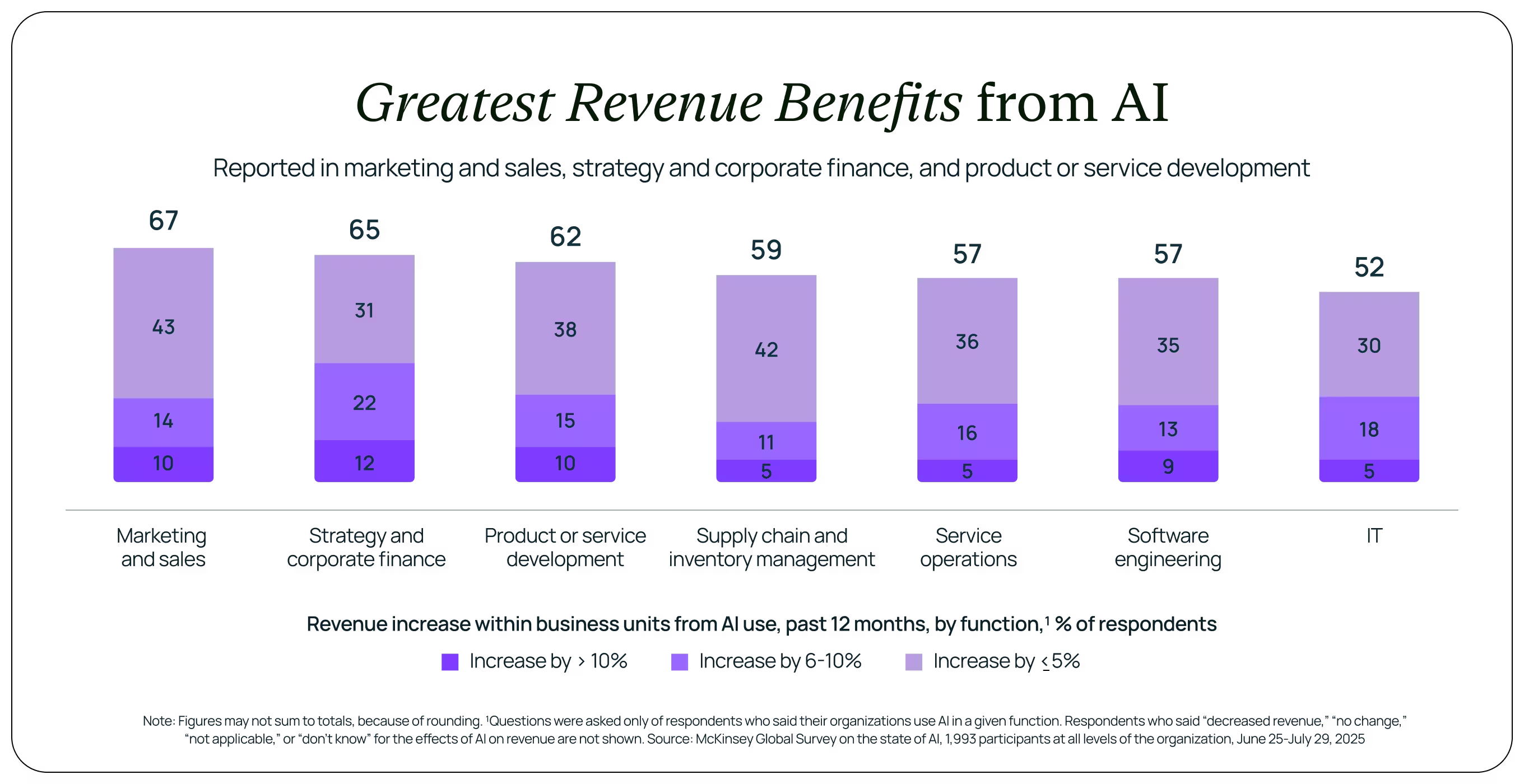
GTM organizations are uniquely primed to capture value from AI. According to McKinsey, the strongest revenue impact shows up in marketing and sales, with additional gains across strategy, finance, and product development. Efficiency may be the entry point, but growth is the payoff.
How growth-minded GTM organizations are approaching AI in 2026
The first step in AI adoption is still productivity, and Gartner expects this foundation to continue to strengthen in the coming years. They predict that 95% of seller research workflows will begin with AI by 2027, a dramatic leap from less than 20% in 2024. The implication is clear: teams must first use AI to streamline tasks like research, analysis, and summarization before expecting it to drive outcomes such as conversion or revenue lift.
[BLOCKQUOTE
| Quote: While I don't see AI as a tool that can totally displace the planning process as it exists today, AI definitely helps make our jobs more efficient.
| Author: Katia Terentyeva
| Title: Head of Global Sales Compensation Operations, Elastic
]
Her team uses AI to generate charts, benchmark plan structures, model scenarios, and validate all required process steps and stakeholders.
As organizations mature, they begin shifting from “raw data” to what Gartner describes as “atomic insights”: AI-generated, synthesized perspectives built from analyzing multiple data sources. These insights give sellers and planners a coherent, actionable point of view about a customer, product, or opportunity.
Narrative automation then translates these insights into targeted messaging or planning recommendations, reducing the manual effort required to personalize communication or prepare strategic materials.
The next leap: Agentic AI in sales planning
Agentic AI represents the next evolution in this journey: systems that don’t just support decisions but actively reason, plan, and take action within defined boundaries. This is where sales planning is headed in 2026 and beyond.
The benefits extend well beyond efficiency. Agentic systems can elevate decision-making by analyzing large datasets, identifying trends, and producing clear, actionable recommendations that help leaders size quotas, evaluate territories, or model potential outcomes with greater confidence. And because these systems can orchestrate multi-step processes on their own, they dramatically increase productivity and lower operational costs, allowing teams to redirect their time toward higher-value strategic work.
[BLOCKQUOTE
| Quote: On the territory planning side of things, we'll see AI and tooling that will help with smarter allocation, with improved fairness and distribution. Predictive models will help score accounts, estimate quota potential, and right-size quotas and territories by rep and segment. Lastly, something that we've started to ‘drink our own champagne’ with at CaptivateIQ relates to governance and risk in things like anomaly detection on payouts. We're essentially able to catch outliers earlier, so that we can prevent month-end fire drills and disputes with the team before the payroll cycle closes rather than after.
| Author: Johnathan Warren
| Title: Director of Revenue Operations, CaptivateIQ for The Multiplier
]
Where AI in Sales Planning Goes from Here
As 2026 begins, sales organizations stand at an inflection point. Adoption is widespread, but maturity varies. Efficiency gains are common, but growth gains remain limited to the most forward-thinking teams. AI today is largely assistive, but it is rapidly moving toward a future in which it will analyze, recommend, and eventually orchestrate key parts of the planning process.
Teams that remain in the “copilot phase” will continue to see incremental improvements. But teams that embrace agentic AI, atomic insights, and autonomous planning workflows will redefine how revenue organizations operate altogether.
The organizations that win in 2026 won’t simply use AI to do the same work faster; they’ll use it to further optimize their programs and unlock revenue.
Lorem ipsum dolor sit amet, consectetur adipiscing elit. Suspendisse varius enim in eros elementum tristique. Duis cursus, mi quis viverra ornare, eros dolor interdum nulla, ut commodo diam libero vitae erat. Aenean faucibus nibh et justo cursus id rutrum lorem imperdiet. Nunc ut sem vitae risus tristique posuere.
