The Demo Trap: How to Avoid AI Tools That Don’t Deliver
Every sales performance management (SPM) vendor touts an impressive AI demo. The AI summarizes compensation plans, flags anomalies, answers questions instantly, and generates reports in seconds.
Product demonstrations highlight AI at its best. The harder question is how it performs after months of compensation changes, seller inquiries, payout disputes, and evolving business priorities. That's the demo trap: evaluating AI based on what it demonstrates in a controlled environment instead of how it supports the work compensation teams do every day.
That distinction is becoming more important as the category itself changes. The Gartner® 2026 Magic Quadrant™ for Sales Performance Management describes SPM as shifting from a narrowly focused compensation administration tool into a broader, cross-functional planning domain anchored in RevOps principles — one where buyers expect SPM platforms to enable integrated decision making across sales, finance, HR and IT, supported by AI capabilities, trustworthy data and scalable architecture.
The strongest AI platforms create value long after the demo ends by helping compensation teams work more accurately, efficiently, and strategically.
CaptivateIQ's research suggests many organizations are still working through that distinction. AI adoption is widespread, but much of it remains focused on streamlining work instead of transforming how compensation teams operate. While 81% of compensation teams now use AI in some capacity, up 16% year over year, only 28% use it extensively.
"The gap between 'we use AI' and 'we use it extensively' is the gap between a tool and a solution."
— CaptivateIQ’s 2026 State of Incentive Compensation Management (ICM) report
AI adoption is still concentrated in low-stakes tasks
The current state of AI adoption helps explain why so many organizations struggle to move beyond productivity gains.
In sales, AI is most commonly used for customer research (43%), content creation (39%), call and meeting analysis (35%), administrative tasks (30%), and prospecting (29%). These are valuable use cases, but they share an important characteristic: they support work that people are already doing without significantly changing business decisions.
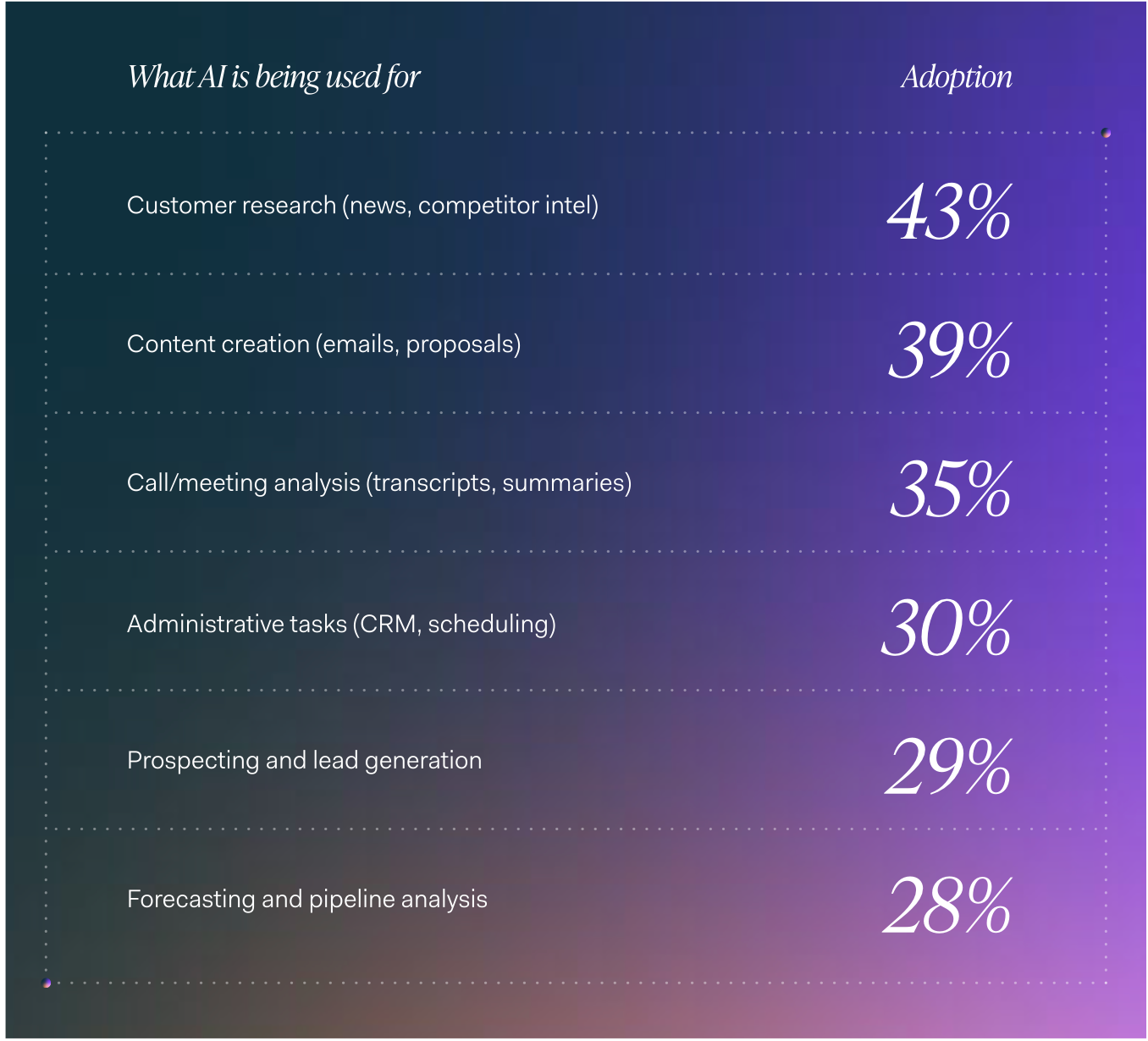
Usage drops as the stakes increase. Just 28% of respondents use AI for forecasting and pipeline analysis, where recommendations have a direct impact on revenue planning and resource allocation.
The same pattern appears in compensation. Teams most commonly use AI to summarize insights (67%), automate manual tasks (64%), create dashboards and reports (53%), and communicate compensation plans (53%). Far fewer use AI for plan design, payout modeling, or compensation strategy, where decisions directly influence seller behavior and business performance.
That doesn't mean AI’s impact has been limited. Organizations report improvements in data access (62%), visibility (59%), commission accuracy (58%), and administrative efficiency (56%). Those are meaningful gains that help compensation teams operate more efficiently and with greater confidence.
Most organizations, however, are still applying AI to optimize existing processes instead of reshaping how compensation decisions are made. That distinction matters. If your goal is to build a more agile compensation operation, look beyond standalone capabilities and evaluate how AI supports the workflows, decisions, and outcomes that drive long-term business performance.
Why AI adoption stalls
If AI can improve productivity, why are so many organizations still limiting it to operational tasks?
Confidence remains one of the biggest barriers to broader AI adoption. Accuracy is the number one barrier to AI adoption among both sales professionals and compensation teams that haven't yet adopted AI. Beyond accuracy, respondents cite security concerns, integration challenges, and uncertainty about return on investment as the biggest reasons for holding back.
That hesitation doesn't match what the data shows. Organizations using SPM technology are 2.6 times more likely to hit target profitable revenue growth than those without it, according to Gartner report “2026 Top 10 Technology Markets for Chief Sales Officers".
Confidence also remains a hurdle for organizations already using AI. Twenty-six percent of sales professionals say today's tools are too basic to deliver meaningful value, 20% say they haven't been properly trained, 17% struggle to integrate AI into existing workflows, and another 17% simply prefer to do the work manually.
Those concerns make sense when you consider the complexity of compensation. AI can draft content, summarize information, and surface insights quickly. Compensation decisions demand something different. Prioritization, forecasting, plan design, and payout decisions all require a deeper understanding of how the business operates.
That understanding comes from context. Success depends on business rules, territory logic, quota structures, approval workflows, historical plan performance, and strategic intent. Many AI tools can analyze raw data. Fewer can interpret it within the realities of a company's compensation program. Without that context, even technically correct outputs can feel generic, incomplete, or disconnected from how the organization actually operates.
The most valuable AI doesn't simply answer questions. It supports better decisions. As you evaluate platforms, look beyond the number of capabilities they advertise and ask whether the AI understands the context your compensation team relies on every day.
The six questions that follow will help you evaluate platforms based on the outcomes they enable, rather than the capabilities that are easiest to demonstrate.
Six questions to ask during every AI demo
AI is remarkably good at completing individual tasks during a demo. What buyers can't fully evaluate in a product demonstration is how AI will perform after months of compensation changes, seller inquiries, payout disputes, and evolving business priorities.
Keep your evaluation focused on the outcomes AI should deliver over time. In CaptivateIQ's 2026 State of AI in Sales Planning and Incentives report, compensation leaders identified improving payee experiences (54%), report and data generation (54%), error detection (50%), and inquiry deflection (46%) as the areas where AI is expected to have the greatest impact over the next two to three years. The following questions are designed to help you determine whether a platform can deliver those outcomes in day-to-day operations.
1. Can it catch problems before they become payout disputes?
Half of compensation leaders expect error detection to be one of AI's biggest contributions over the next two to three years. Don't stop at asking whether AI can identify an obvious mistake. Ask your vendor to demonstrate how it detects anomalies within a realistic compensation plan that includes overlapping rules, exceptions, accelerators, and changing quotas. The greatest value comes from preventing errors before payouts are calculated.
2. Can reps understand their compensation without involving an administrator?
More than half of leaders (54%) believe one of AI's greatest impacts will be improving the payee experience. During a product evaluation, don't settle for watching an administrator ask questions. Ask to see a seller explain their own earnings, understand a payout calculation, or interpret a compensation plan without needing someone from the compensation team to translate it. A stronger payee experience builds confidence in both the payout and the compensation program itself.
3. Does it eliminate administrative work, or simply move it somewhere else?
Nearly half of organizations (46%) expect AI to reduce employee inquiries. That outcome matters more than generating faster answers. Ask how AI changes the volume of questions reaching compensation administrators after implementation. If every response still requires a human to review or explain it, the administrative burden hasn't actually changed.
4. Does it help you make better decisions, or simply deliver information?
Compensation leaders expect AI to accelerate report and data generation (54%) so they can identify issues sooner and act with greater confidence. Ask whether the platform surfaces actionable insights in real time or simply makes existing reports easier to navigate. The strongest platforms help teams move quickly from insight to action.
5. Does it work the way your compensation program works?
Every compensation program is different. Business rules, quota structures, territory assignments, approval workflows, exceptions, and historical decisions all shape how compensation is designed and managed. Ask whether the AI understands those realities or relies on disconnected systems that produce generic responses.
This becomes even more important as compensation programs grow more dynamic. Organizations that adjust incentive plans weekly are more than three times as likely to use AI extensively as those that rarely make changes. As compensation becomes more agile, AI delivers greater value when it's embedded directly into the workflows your team already uses.
6. Will your team actually trust it enough to use it?
Ultimately, AI only creates value when it becomes part of everyday work. CaptivateIQ's research found that seven of the top 20 predictors of organizational preparedness are AI-related, including extensive AI adoption, embedding AI within the ICM platform, using AI for strategy recommendations, improving compensation accuracy, and reducing employee inquiries. Organizations are also beginning to raise expectations accordingly. Forty-three percent already incorporate AI productivity into seller quotas, while another 41% plan to do so. That expectation tracks with performance: Sellers who effectively partner with AI are 3.7 times more likely to meet quota than those who don't, according to a September 2024 Gartner survey of more than 1,000 B2B sellers.
How CaptivateIQ delivers business value with AI
CaptivateIQ was named a Leader in the Gartner 2026 Magic Quadrant for Sales Performance Management — a recognition Gartner give to for platforms that, in its words, "execute well against their current vision and are well positioned for tomorrow.”
That's the same philosophy behind CaptivateIQ's approach to AI throughout this piece: instead of a standalone assistant, AI embedded directly into compensation workflows — catching anomalies before they become payout disputes, explaining plans in a seller's own language, and taking action inside the workflows your team already runs, rather than sitting alongside them.
That emphasis on operational impact is reflected in the Gartner 2026 Magic Quadrant for Sales Performance Management. In its evaluation of CaptivateIQ, Gartner wrote: 'The modeling add-on, Catalyst, supports tangible outcomes such as anomaly detection, forecasting, natural language plan explanations, and workflow automation, rather than generic copilots. This approach reinforces trust and usability in compensation and planning processes."
Gartner adds: “Their AI is embedded, not bolted on: Assistants and agents take action within workflows, enabling users to move from insight to execution (e.g., adjusting plans, resolving inquiries, rebalancing territories) in a governed, auditable manner."
Turn AI into a strategic compensation advantage
The best AI platforms deliver value long after implementation. As you evaluate vendors, consider how AI will support your compensation organization after months of plan changes, seller questions, payout reviews, and evolving business priorities.
Focus on outcomes. Look for AI that reduces errors, improves the payee experience, eliminates administrative work, and helps your team make better decisions over time.
Organizations that realize the greatest value from AI evaluate it through that lens from the very beginning.
Want to dive deeper? Explore the findings from CaptivateIQ's 2026 State of AI in Sales Planning and Incentives report, or see how Gartner evaluated leading SPM vendors in the 2026 Magic Quadrant for Sales Performance Management.
<hr>
Lorem ipsum dolor sit amet, consectetur adipiscing elit. Suspendisse varius enim in eros elementum tristique. Duis cursus, mi quis viverra ornare, eros dolor interdum nulla, ut commodo diam libero vitae erat. Aenean faucibus nibh et justo cursus id rutrum lorem imperdiet. Nunc ut sem vitae risus tristique posuere.
