.svg)
Is AI actually improving your revenue strategy or just making it faster?


Executive Summary
AI is everywhere. But its impact isn’t where most teams expect.
Organizations are under pressure to move faster — faster planning, faster forecasting, faster decision-making. AI promises all of it.
And in many ways, it delivers.
But speed isn’t the same as strategy.
Most teams are using AI to automate tasks, summarize information, and reduce manual work. But when it comes to high-stakes decisions — forecasting revenue, setting quotas, designing compensation — adoption slows.
This is where the gap appears.
The challenge isn’t whether AI is being used. It’s whether it’s being used to actually shape performance.
What you’ll learn
Inside this report, you’ll uncover:
- Where AI is already delivering measurable value
- Why most usage is still limited to low-impact workflows
- What separates teams using AI for speed vs strategy
- The barriers preventing deeper adoption
- What needs to change for AI to influence real decisions
Why this matters
AI Adoption ≠ AI Impact
Most teams have adopted AI — but primarily for basic tasks, not strategic decisions.
Speed Without Strategy Falls Short
Faster workflows don’t change how revenue decisions are made — or how performance improves.
The Next Advantage Is Intelligence
Teams that embed AI into planning and compensation gain visibility, alignment, and adaptability.
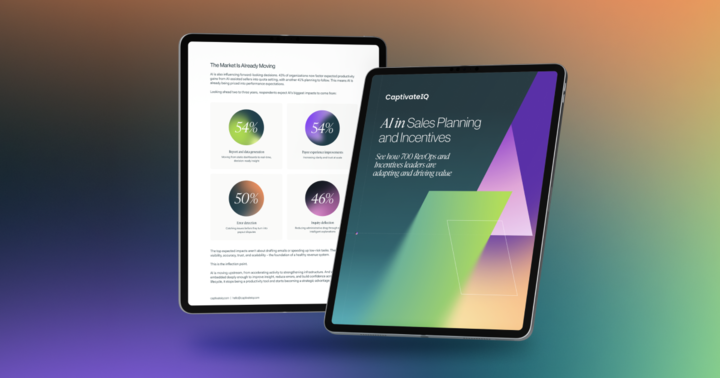
AI Is widespread but still underutilized where it matters
81%
of sales professionals are already using AI in some part of their workflow
Only 28%
use AI for forecasting and pipeline decisions — where strategy is defined
62%
say AI improves access to data and insights, but not necessarily decisions
Go Beyond the Surface-Level Use Cases
Get the full breakdown of how AI is being applied across revenue teams — and where it’s creating real advantage.
Where AI delivers today
and where it doesn’t
See the full breakdown of AI maturity- Where AI Delivers — and Where It Falls ShortAI is already improving speed across revenue teams — automating tasks, summarizing data, and reducing manual work. But when it comes to the decisions that actually shape performance, adoption drops and impact becomes less clear.
- From Automation to IntelligenceMost teams use AI to move faster. Few use it to make better decisions. The next phase isn’t about doing more with AI — it’s about using it to model, evaluate, and guide revenue strategy.
- The Gap Isn’t Capability — It’s ContextAI tools can generate insights, but without understanding how your business actually operates — compensation rules, territories, quotas — those insights stay surface-level.
How to apply this to your team
- Where is AI saving time vs shaping decisions?
- Which decisions still rely on manual judgment?
- Where does lack of context limit AI usefulness?
Move AI closer to the decisions that define performance — not just the workflows that support it.
Continue learning
.avif)