.svg)


11 Best Sales Performance Management Software For 2026

So, you’ve decided you want to invest in sales performance management (SPM) software, but with the dozens of options on the market, you’re spoiled for choice.
While many of the tools offer similar capabilities, the right platform depends on factors like team size, compensation complexity, and whether you need full SPM functionality or just commission management. A tool built for a 30-person sales team may struggle to handle enterprise compensation plans with multiple territories, overlays, and global payouts. Choose the wrong software, and you’ll waste time on implementation only to have to return to the drawing board.
This guide breaks down the 11 best sales performance management software platforms for 2026, highlighting what each tool does best and which types of teams should consider it. If you're actively evaluating SPM software, this comparison will help you narrow the shortlist quickly.
Key Takeaways
- CaptivateIQ is the strongest all-around SPM platform for mid-market and enterprise teams. The software includes flexible commissions, territory planning, quota setting, and forecasting in one system.
- Match the platform to your scope. Some tools specialize in commission automation, while others offer full sales performance management across incentives, territories, quotas, and planning.
- Team size and compensation complexity matter. Platforms built for small teams may struggle with multi-layered commission structures, global payouts, or large revenue organizations.
- Your existing tech stack should influence the shortlist. SPM platforms rely on data from systems like your CRM, ERP, and HRIS, so strong integrations are critical.
- Pricing models vary widely. Vendors charge per payee, per user, or through custom enterprise contracts, so total cost often depends on team size and feature scope.
Sales Performance Management Software Comparison
Below is a quick overview of each tool covered in this list, so you can get a feel for your options side by side.
The 11 Best Sales Performance Management Software Platforms
The platforms below are the best sales performance management software available in 2026. Each tool stands out for a different reason, from full-suite SPM capabilities to specialized strengths in commission automation, territory planning, or enterprise scalability.
1. CaptivateIQ
Best for: Mid-market and enterprise teams that need a flexible, full-suite SPM platform covering commissions, territories, quotas, and planning.
CaptivateIQ is a modern sales performance management platform designed to connect incentive compensation and sales planning in one system.
At the core of the platform is SmartGrid. SmartGrid is CaptivateIQ’s proprietary data and calculation engine that takes in data from CRM, ERP, HRIS, and other internal systems. From there, RevOps teams can model complex commission plans with tiers, accelerators, splits, and overlays without relying on engineering support. That makes it easier to adjust plans as roles, products, or go-to-market strategies change.
Teams can also manage calculations, generate reports, and analyze sales performance in the same system, reducing the manual work that often comes with spreadsheet-based processes.
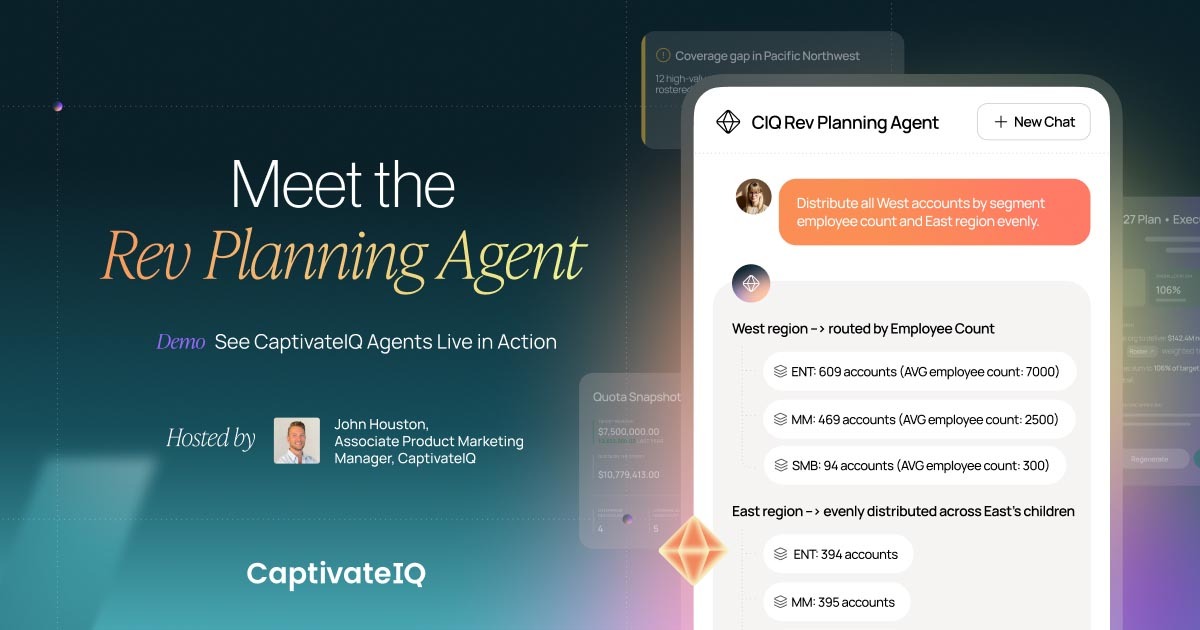
Beyond incentive compensation, CaptivateIQ now supports full sales performance management through CaptivateIQ Planning. Revenue teams can plan headcount, carve territories, and set quotas in the same system where commissions are calculated, so planning decisions flow directly into compensation plans. For example, teams can model hiring and ramp scenarios to meet revenue targets, distribute accounts across balanced territories, and generate quotas using role logic, ramp assumptions, and historical performance data.
The platform has also received strong industry validation. CaptivateIQ was named a Leader in the Forrester Wave. It earned the highest possible scores in 12 criteria, including innovation, AI capabilities, and time-to-value. It also ranks #1 in Sales Compensation on G2, reflecting strong adoption among revenue operations and finance teams.
Because it connects planning, incentives, and performance data in a single platform, CaptivateIQ is one of the few tools that truly covers the full sales performance management lifecycle rather than focusing solely on commission automation.
2. Xactly
Best for: Large enterprises that need mature, established SPM with deep benchmarking data and compliance features.
Xactly is one of the longer-tenured enterprise SPM vendors, with separate products that cover incentive compensation (Incent), territory and quota management (Manage), sales planning (Plan), and forecasting (Forecast).
The platform is known for its sales benchmarking dataset built from years of pay and performance history, which can be useful when you’re pressure-testing plan changes, payout curves, or quota models in a highly governed environment.
Xactly tends to work well in regulated or audit-heavy companies where documentation, approvals, and traceability are non-negotiable. The tradeoff is that it can feel more “enterprise software” than newer platforms, and implementations often take longer and require more internal admin effort than mid-market-first tools.
3. Varicent
Best for: Large enterprises with highly complex compensation structures across multiple divisions and geographies.
Varicent is built for organizations where incentive plans get complicated fast. If your comp plan includes layered roles and overlapping crediting, or if your Sales team sits downstream of heavy scrutiny from Finance, Varicent may be a good fit.
That’s because Varicent supports detailed crediting rules, layered roles, and multi-level compensation structures, which help teams manage plans where revenue is split across multiple contributors or regions. It also provides strong audit trails and approval workflows, which can be important in organizations where Finance closely reviews compensation calculations.
The software covers incentive compensation management and also includes sales planning capabilities for territories and quotas.
Varicent emphasizes auditability and data controls through detailed calculation traceability, version history, and approval workflows. These features make it a fit in highly regulated industries like financial services, insurance, and healthcare that need to explain exactly how payouts were calculated and prove the logic behind changes over time.
With Varicent, teams usually need solid technical support and a dedicated comp admin function to maintain data flows, keep models clean, and manage ongoing plan changes at enterprise scale.
4. Salesforce Spiff
Best for: Organizations already in the Salesforce ecosystem that want native commission management within Sales Cloud.
Salesforce Spiff is Salesforce’s incentive compensation management tool. Originally built as a standalone product, it was acquired by Salesforce and integrated into Sales Cloud as the platform’s commission management layer.
Spiff automates commission calculations and provides reps with real-time visibility into their earnings through dashboards and commission statements. These statements trace exactly how payouts were calculated, which helps reduce disputes and gives sellers a clearer connection between deals and earnings.
Compensation teams configure plans through a low-code commission designer. Instead of writing formulas or relying on engineers, administrators can define rules for rates, tiers, accelerators, and crediting logic using a visual interface. This makes it easier to adjust compensation plans as products, territories, or roles change.
Spiff also includes collaboration and AI features designed to reduce routine comp questions. Reps can leave comments directly on commission statements, and a conversational AI assistant can answer questions about earnings, attainment, and payout logic without requiring the comp team to investigate every request.
The platform’s biggest advantage is its deep integration with Salesforce. When Salesforce is already the system of record for opportunity and pipeline data, Spiff can pull that information directly to calculate commissions and display earnings in the same environment where reps manage deals.
That tight integration also means Spiff is most valuable for companies already operating heavily within Salesforce. Organizations whose compensation logic relies on multiple external systems, such as ERP, billing platforms, product usage data, or HRIS tools, may find that standalone SPM platforms offer more flexibility for cross-system data modeling.
5. Forma.ai
Best for: Enterprise sales operations teams that want AI-driven compensation design and optimization.
Forma.ai combines incentive compensation management with territory and quota planning. Teams can choose from a library of plan components and templates, and then use AI to fit those pieces together into an effective compensation plan.
Forma.ai uses AI to simulate plan changes, test payout scenarios, and analyze how incentive structures affect sales performance before deploying them. Forma.ai also integrates with a wide range of data sources (200+), which allows companies to incorporate CRM, ERP, and other operational data into compensation modeling and sales planning.
The main tradeoff is cost and implementation complexity. Forma.ai does not list public pricing. Instead, it offers custom enterprise contracts, often paired with an upfront implementation fee. The platform generally fits larger enterprises with dedicated RevOps or compensation teams rather than smaller teams looking for a quick rollout.
6. Everstage
Best for: Mid-market teams that want fast implementation and best-in-class commission automation.
Everstage models commission plans, automates calculations, and gives sellers real-time visibility into earnings through dashboards and commission statements. The product also includes Crystal, a forecasting feature that lets teams model expected commission payouts based on current performance.
Everstage recently expanded beyond core commissions. It now includes modules for quota planning, territory design, and CPQ-style quoting workflows. This helps revenue teams align compensation with how territories, quotas, and deals are structured, instead of managing those processes in separate tools.
The platform holds one of the highest ratings in the category on G2 (4.9/5), and customers often highlight fast implementation and a relatively quick path away from spreadsheet-based commission processes.
Even with those additions, Everstage still centers on commission automation. Organizations that mainly need accurate payouts and better rep visibility tend to see the most value, while companies looking for deeper planning capabilities across territories, quotas, and capacity may evaluate more full-suite SPM platforms.
7. Performio
Best for: Mid-market and enterprise teams that need reliable commission tracking with an intuitive interface.
Performio calculates commissions and tracks incentives with a component-based plan-builder that keeps compensation rules structured and easier to manage than spreadsheet formulas. Reps can also trace payouts through dashboards and commission tables that show exactly how each deal contributes to earnings.
Performio also provides tools that help compensation teams monitor and validate payouts. Reporting dashboards and audit logs allow admins to review how commissions were calculated, track payout trends over time, and investigate discrepancies when questions arise.
On the rep side, dashboards show earnings updates, attainment progress, and leaderboard rankings tied to current performance. When sellers can see how closed deals affect their earnings, they’re less likely to file commission disputes and more likely to focus on deals that move them closer to quota.
The main limitation is scope. Performio is strongest as an incentive compensation management platform rather than a full sales performance management suite. Teams primarily trying to replace spreadsheets and ensure commission accuracy tend to get the most value, while organizations that need deeper territory, quota, and capacity planning may look for a broader SPM platform.
8. QuotaPath
Best for: Growing sales teams transitioning from spreadsheets to automated commission tracking.
QuotaPath helps teams replace manual commission spreadsheets with a system that pulls deal data directly from their CRM. It calculates commissions automatically and shows reps how each deal affects their earnings through dashboards, attainment tracking, and leaderboards.
Plan creation is handled through an AI-assisted plan builder that helps teams structure quotas, accelerators, and commission rates without writing formulas. That reduces the time and risk involved in building compensation plans compared to managing complex spreadsheet formulas.
QuotaPath integrates with common sales and finance tools, including Salesforce, HubSpot, Stripe, and QuickBooks, so you can pull all of your data into the same tool.
The platform is built for simplicity and fast setup, which makes it popular with smaller and mid-sized teams. However, organizations running highly complex global compensation plans may eventually grow out of QuotaPath.
9. Anaplan
Best for: Large organizations that want to connect sales performance management with broader financial and operational planning.
Anaplan is a broader sales planning platform that many enterprises use across finance, workforce, supply chain, and go-to-market planning. For sales teams, that means territory and quota plans can sit inside the same planning environment as headcount, budgeting, and revenue forecasts. This helps organizations align sales capacity, targets, and financial plans so changes in hiring or revenue targets flow through to quotas and territory coverage.
Sales teams can model territory coverage, quota changes, and revenue outcomes across regions, business units, and time periods, and then compare different versions before committing to a plan. Anaplan also brings in AI and forecasting capabilities through products like Forecaster, Optimizer, and CoPlanner. These help teams analyze historical performance data, model future outcomes, and test planning scenarios before making decisions.
However, Anaplan makes the most sense as a broader enterprise planning investment, not just a point solution for sales comp or SPM. Companies using it only for sales performance management may find the licensing, implementation work, and in-house model management heavier than they need.
10. SAP Commissions (CallidusCloud)
Best for: Large enterprises already using the SAP ecosystem that need enterprise-grade commission processing.
SAP Commissions, originally developed as CallidusCloud before SAP acquired it in 2018, is now part of the SAP SuccessFactors portfolio. The platform focuses on administering complex global compensation plans and processing large volumes of commission transactions across distributed sales teams.
Administrators can design and test incentive plans using configurable templates and drag-and-drop components, while built-in reporting shows payout calculations, earnings estimates, and quota attainment. The platform also includes approval workflows, dispute management tools, and integrations with payroll and HR systems to support end-to-end compensation operations.
Organizations already running SAP systems for HR, finance, or ERP can connect compensation data into the same environment. But the platform reflects its legacy roots. Interfaces and workflows can feel dated compared to newer SPM tools, and implementations often require SAP consulting support and longer deployment timelines.
11. SPOTIO
Best for: Field sales teams that need location-based activity tracking alongside performance management.
SPOTIO is built specifically for outside sales teams that spend most of their time in the field rather than inside a CRM.
The platform combines territory mapping, lead management, and route optimization so reps can plan visits, track prospects, and log activity directly from a mobile app.
Managers get visibility into field activity through location-verified check-ins, performance dashboards, and leaderboards that connect daily activities like visits, meetings, and follow-ups to sales outcomes. Territory performance reports also help teams understand which areas generate the most pipeline and revenue.
The platform focuses on field productivity rather than compensation administration. SPOTIO is typically used alongside a CRM or compensation platform rather than replacing them. Teams that mainly need commission automation or complex incentive management will likely need a different type of SPM tool.
How to Choose the Right Sales Performance Management Software
Not every SPM platform solves the same problem. Some tools focus on commission automation, while others cover the full sales planning stack, including territories, quotas, forecasting, and capacity modeling.
Before narrowing your shortlist, it helps to evaluate a few practical factors that determine which platforms will actually fit your organization.
Match Platform Scope to Your Needs
Define the problem you're trying to solve. Some teams simply need to replace spreadsheets with automated commission calculations, while others need a broader system that connects compensation with territory design, quota setting, and capacity planning.
Talk with the stakeholders in RevOps and Finance who touch compensation day-to-day to understand where the current process breaks down.
Choose a platform with the right scope
Start by mapping the processes your team currently manages around compensation and sales planning. Look at where commissions are calculated, how quotas are set, how territories are assigned, and where forecasting happens. If most of that work happens in spreadsheets, and your main challenge is running commissions accurately, an incentive compensation tool may be enough. If planning activities like territory design, headcount modeling, and quota setting are tightly tied to compensation decisions, a full SPM platform will likely be a better fit.
Paying for a full SPM suite when you only need commission automation adds unnecessary complexity. At the same time, teams often underestimate how quickly compensation plans become more complicated as headcount, products, and sales roles expand.
Evaluate Integration With Your Existing Stack
SPM software relies on clean operational data. Commission calculations typically depend on opportunity data from your CRM, invoice or payment data from your ERP or billing system, and employee records from HRIS platforms.
Before selecting a tool, confirm that it integrates with the systems where your deal, revenue, and employee data already live. Native integrations reduce the amount of manual data syncing required to keep commission calculations accurate. For example, organizations heavily invested in Salesforce often prioritize platforms that integrate directly with Sales Cloud.
Consider Implementation Timeline and Resources
SPM platforms vary widely in how long they take to implement and how much internal support they require. Implementation effort usually depends on two things: the complexity of your compensation plans and the number of systems that need to feed data into the platform.
Plans with multiple roles, layered crediting rules, and global payout structures require more configuration. Integrations with systems like CRM, ERP, billing, and HRIS can also add setup time, especially if the platform relies on custom integrations instead of native connectors.
Long-term ownership matters as well. Some enterprise platforms require dedicated compensation administrators or technical resources to maintain plan logic and data pipelines. Others are designed so RevOps teams can manage plans and reporting directly through configuration tools.
Enterprise systems such as Xactly, Varicent, and SAP Commissions typically offer deeper customization but require longer deployments. Platforms like CaptivateIQ, Everstage, and QuotaPath are generally designed for faster setup and easier ongoing management.
FAQ
What is sales performance management software?
Sales performance management (SPM) software helps companies design, manage, and analyze how sales teams are compensated and measured. These platforms typically handle commission calculations, track quota attainment, and provide reporting on sales performance.
Many SPM systems also support territory planning, quota setting, and forecasting, so sales leaders can align incentives with revenue goals.
What's the difference between SPM and ICM software?
Incentive compensation management (ICM) software focuses specifically on calculating and managing commissions and bonuses.
ICM is a part of sales performance management (SPM) platforms, but SPMs cover a broader scope. In addition to commission administration, they often include territory management, quota planning, capacity modeling, and forecasting.
Many companies start with ICM to replace comp spreadsheets, then expand to full SPM as their sales organization grows.
How much does sales performance management software cost?
Pricing varies widely depending on the platform and company size.
Some tools charge per user or per payee, while enterprise platforms typically use custom pricing based on implementation scope and data volume.
Smaller tools may start around $25–$50 per user per month, while enterprise SPM platforms often involve annual contracts and implementation fees.
What features should I look for in SPM software?
Key SPM software features include automated commission calculations, clear payout visibility for reps, reporting and analytics, and integrations with systems like CRM and ERP.
More advanced platforms also offer territory planning, quota management, forecasting, and scenario modeling to help revenue leaders design and test compensation strategies.
How long does it take to implement SPM software?
Implementation timelines vary by platform complexity. Lightweight commission automation tools can sometimes be deployed in a few weeks, especially for smaller teams with straightforward plans.
Enterprise SPM systems with complex compensation structures and multiple integrations may take several months to implement and configure.
Can SPM software integrate with my CRM?
Yes. Most SPM platforms integrate with CRM systems, such as Salesforce or HubSpot, because commission calculations rely on deal and pipeline data.
Find the Right SPM Platform for Your Team
Choosing the right sales performance management software ultimately depends on your team’s size, compensation complexity, and planning needs.
Some organizations only need commission automation, while others benefit from a full platform that connects incentives with territories, quotas, and revenue planning.
For teams that want a flexible, full-suite SPM platform that balances powerful modeling with an intuitive user experience, CaptivateIQ offers one of the strongest combinations of capability and usability on the market. Its SmartGrid calculation engine allows RevOps teams to manage complex compensation plans without engineering support, while CaptivateIQ Planning connects territories, quotas, and headcount planning directly to compensation programs.
If you're evaluating SPM platforms, book a demo to see how CaptivateIQ handles sales compensation management in practice.
_1200x630.png)