.svg)


AI Sales Planning: A Clear Definition, Practical Use Cases, and What Comes Next

AI sales planning is the application of artificial intelligence to sales planning activities like forecasting, territory design, quota setting, and capacity planning, rather than more generic AI sales tools that focus on selling activities like prospecting and outreach.
AI-powered sales planning tools automate lots of the manual data entry and processing that’s required in comprehensive sales planning, and learn from historical performance data to improve planning accuracy over time. Sales teams have already implemented AI tools in many of their common sales tasks, and sales planning is another process that stands to benefit from artificial intelligence.
Key Takeaways
- AI sales planning focuses on adding AI into planning activities rather than actual sales activities.
- Companies can use AI to improve and speed up sales planning activities like forecasting, territory design, and quota setting.
- Used effectively, AI brings tangible, measurable benefits, including time savings and improved quota attainment.
- In the future, teams will be able to use AI to further transform their sales planning process, moving towards real-time planning rather than annual cycles.
What AI Sales Planning Actually Is
AI sales planning uses machine learning and predictive analytics to improve planning activities like forecasting, territory design, quota setting, and capacity planning, which are traditionally done using spreadsheets and human judgment.
The Planning vs. Selling Distinction
Companies are using AI in all aspects of sales, from prospecting to closing. AI sales planning focuses specifically on the planning activities that set sales teams up for success, rather than the actual selling. It applies artificial intelligence, machine learning, and predictive analytics to forecasting, segment and hierarchy design, target allocation, and capacity planning.
How AI Differs From Traditional Planning Tools
Traditional sales planning tools automate the calculations managers and leaders do to build sales forecasts, design territories, and set targets across teams, regions, and products. AI-powered planning tools do the same, but they get smarter over time. They analyze historical performance and use that data to make revenue predictions, improving accuracy over time.
The Data Foundation
AI sales planning uses data from your CRM, ERP, HRIS, and market sources to build your forecasts or design quotas. The platform needs a solid foundation of clean, connected data from those sources to work well. The old saying of “garbage in, garbage out” applies to traditional sales planning tools, but doubly so if you’re using AI, as it’s learning from incorrect or incomplete data, so the trends, behaviors, and insights it provides will be based on poor-quality information.
Practical Use Cases in Production Today
Here are several use cases that are already mature and established, delivering measurable results for businesses today.
Sales Forecasting
AI analyzes historical data, deal activity, and pipeline patterns to generate sales forecasts. AI tools let managers do forecasting more quickly compared to doing it manually, and they also make their forecasts more accurate. Optifai’s Forecasting Study found that “AI-assisted forecasting improves accuracy by 15–25%.” Tools like CaptivateIQ Catalyst use artificial intelligence and machine learning to analyze your own historical data, deal signals, and pipeline patterns to generate accurate, context-aware predictions and forecasts.
Territory Design and Optimization
AI tools help with territory design and optimization by modeling different territory scenarios and divisions based on account potential, rep capacity, rep specialisms, and geographic factors, much quicker than producing manual models. AI tools also optimize territories and balance opportunity distribution across your team by suggesting splits and lead routing based on balanced workloads.
Quota Setting and Allocation
Research by Salesforce found that 84% of sales reps missed their quota in 2024. AI helps companies set realistic quotas by analyzing previous performance, market potential, and rep ramp curves. By using your historic performance data rather than industry benchmarks or gut feel, you end up with quotas and allocation splits that are achievable, realistic, and feel fairer to your sellers, which helps improve team morale and retention.
Capacity Planning
A survey by Runn found that “capacity planning is top priority” for resource managers, but legacy tools limit the accuracy and usefulness of that planning. AI helps with capacity planning by modeling future hiring needs based on growth targets, ramp time, and expected attrition rates. Over time, AI learns from company and rep performance data, as well as pipeline information, to make more accurate and tailored projections. It helps leadership teams understand when they’ll need to hire, and how many reps they’ll need to fuel the company’s projected growth.
Scenario Modeling
Sales teams use AI to run scenario modeling by simulating changes to quotas, territories, or commission rates. The system uses historical performance, pipeline, and seasonal data to predict how changes to these variables will affect rep earnings, quota attainment, and pipeline. Leaders can quickly test out different models or forecast outcomes under different market conditions, so they understand how planned changes will affect the business and their team.
Evidence of Adoption and Results
Companies that are using AI in their sales planning are seeing clear benefits. Here are some ways AI is helping sales orgs.
Quota Attainment
While Salesforce found that 67% of sellers don’t expect to hit quota, Gartner found that sellers who are effectively using AI are 3.7x more likely to meet quota than reps who don’t use AI at all. Using AI in sales planning, specifically to set realistic targets based on past performance, can significantly improve quota attainment rates.
Time Savings
Using AI for sales planning can deliver time savings that seem small when looked at on a per-rep basis. But if you multiply it across all your sellers, every week of the year, it adds up to huge productivity gains.
Salesforce reports that 68% of sales professionals are using generative AI to build sales plans and strategies. They estimate AI saves them “4.5 hours a week,” while AWS Sales reports their AI assistant saves them “at least 15 hours” on enterprise account planning.
Win Rate Improvements
Rolling out AI in your sales planning doesn’t just save you time. It can actually help your sellers close more business. Salesforce has rolled out Agentforce, AI agents that can be tailored to different business use cases. Since rolling it out internally, Salesforce has seen a 10% increase in win rates.
Implementation Challenges
When you want to add AI into your sales planning processes, finding tools is the easy part. Getting your data up to scratch, integrating it with your existing tech stack, and driving adoption across the whole team are far bigger challenges.
Data Quality and Connectivity
AI needs access to a large, clean data set to work well because otherwise it’s learning and making predictions based on incomplete information. But sales and go-to-market data are spread across multiple systems, from your CRM to your enablement platform. With so many data sources, companies are often sitting on lots of duplicate or incomplete records.
Before rolling out an AI sales planning tool, clean up the data across all your different systems to ensure records are complete and free of duplicates. Also check that your AI planning tool can connect with all your different systems, so it can actually access your data for analysis and prediction modeling.
Integration With Existing Workflows
AI tools that live outside your team’s existing workflows will just add another step to their processes, rather than saving them effort. If it doesn’t integrate with your team’s systems, they’ll be forever jumping between tools, copying and pasting inputs rather than being able to focus on a single task.
Integration with your current tech stack, including CRM, communication tools, and planning systems, is essential. This will help AI slot into your existing workflows more easily, increasing adoption and usage rates, with access to the right data at the right time.
Change Management and Adoption
When you’re adding AI into your sales planning processes, you’re asking your sellers and leaders to change the way they’ve been planning up to now. Changing established ways of working is a tough ask, so it’s essential to make the change as smooth as possible with training, vendor support, and phased rollouts.
Unfortunately, most companies haven’t cracked the formula for implementing AI at scale, so AI adoption is varied across the sales org. Salesforce found that less than half of companies (44%) create training programs for employees to help them prepare for using AI tools. To drive adoption, make sure you provide timely, adequate training to help sellers get started and learn the new AI-assisted planning processes.
What Comes Next: The Future of AI Sales Planning
We’re already seeing how AI is transforming traditional sales planning activities, but we’ve only scratched the surface of what the technology can do. AI sales planning is rapidly developing more autonomous, real-time capabilities. Here’s how we expect AI to change sales planning in the coming years.
Autonomous Agents
Gartner predicts that AI agents will outnumber human sellers by 10x by 2028. This will mark a shift from AI being reactive (relying on human sellers asking the AI for specific insights) to proactive (surfacing those insights automatically).
It will be much more common for sales teams to be made up of a mix of human sellers and AI agents, working alongside one another. Sales teams will use AI agents to handle time-consuming, repetitive tasks autonomously, such as monitoring pipeline and alerting human sellers to potential issues, freeing up sales reps to focus on higher-value conversations.
Real-Time Scenario Modeling
As AI becomes more deeply embedded in the sales planning process, companies will move from annual planning cycles to continuous planning. We’ve already seen how AI is used for forecasting, territory design, and scenario modeling, but as it gets access to more data, the AI will be able to model scenarios and changes even faster. AI could run scenario models that take into account the latest market changes and business priorities. This will let sales teams be more agile, updating sales quotas, territory plans, and team targets in real time rather than working from outdated information.
Predictive Coaching
AI will be used to forecast outcomes and plan quotas, but also to improve them. Sales leaders will use AI to provide coaching to reps in the form of call analysis, real-time feedback, and role-plays. According to Mindtickle, “It takes a human 17 minutes to review a role-play,” while their AI platform does it in 60 seconds, meaning managers can use AI to offer more frequent training and coaching without it taking up all their work hours.
As well as providing coaching and feedback more quickly, AI will tailor and personalize coaching at scale. AI can access sellers’ call recordings, emails, and CRM data from their historic pipeline and deal flow to identify specific weaknesses, skill gaps, or missed opportunities. Then the platform provides targeted training and resources so reps are able to make incremental improvements based on their specific skill gaps.
FAQs
What is AI sales planning?
AI sales planning uses machine learning and predictive analytics to forecast revenue, set quotas, design territories, and model compensation more accurately. It analyzes historical performance, pipeline data, and market signals to create data-driven sales plans.
How is AI used in sales planning today?
Teams use AI to forecast bookings, simulate quota and compensation scenarios, and optimize territory and capacity models. It helps teams spot coverage gaps and risks before plans go live. Sales leaders also use AI to pressure-test plan changes and align incentives with business goals.
What data do I need for AI sales planning?
You need clean historical sales data, pipeline and CRM records, quota and compensation history, and rep performance metrics. If you can provide richer and more consistent data, you will get more accurate, data-informed predictions.
How long does it take to implement AI sales planning?
Basic implementations can take a few weeks once data sources are connected and cleaned. More advanced use cases like territory redesign or compensation plan simulation may take a few months, depending on data quality, tool integration depth, and planning complexity.
Will AI replace sales planners?
No. AI supports sales planners rather than replacing them. It handles data-heavy modeling and forecasting, while humans provide judgment, strategy, and stakeholder alignment. The best results come from combining AI insights with experienced RevOps leadership.
Start With Your Biggest Planning Constraint
When you add AI into your planning processes, start with a task that requires a lot of manual work and effort, such as sales forecasts that take a long time to produce (and are never as accurate as you’d hoped). Clean up your CRM and billing data to ensure you have a solid, accurate data foundation to feed into your AI tool. This should help you see the benefits of AI more quickly, as it will have access to all the data it needs at the start.
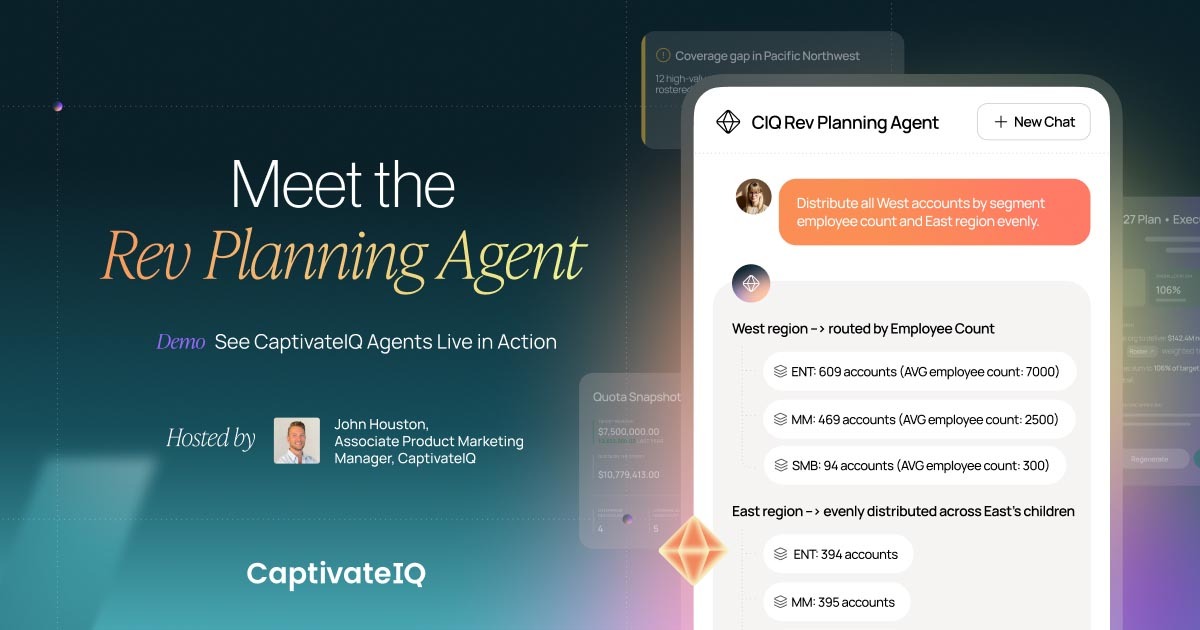
CaptivateIQ Planning helps companies streamline their planning process, optimizing sales forecasts, setting quotas, and balancing territories quickly and easily. Book a demo to learn more.
_1200x630.png)